AI Can Create the Campaign. Creative Direction Makes It a Brand.
What I look for in AI creative: the concept, the execution, and the decisions that make an image belong to a particular brand.
I remember seeing a creative on Instagram that stopped me.
A subway train was at the platform, and what looked like hundreds of handbags were spilling out of the train doors.
The scale was impossible. But the setting, styling, and presentation made it feel like a fashion campaign. There was an idea behind it. Someone had considered how to place an ordinary product in an extraordinary scene.
That’s what interested me.
When I look at AI creative, I’m looking for the concept, the execution, and the decisions that make the image belong to a particular brand.
The concept comes before the prompt
A handbag on a clean background and a train overflowing with handbags communicate differently.
One presents the product. The other creates a moment around it.
Neither approach is automatically the right choice. That depends on what the brand needs the creative to accomplish.
Are we introducing a product? Creating anticipation? Showing how something fits into a customer’s life? Giving people a reason to stop and look?
Those questions should shape the idea before anyone opens an AI tool.
When a business begins with “make something luxurious,” it leaves most of the creative decisions unresolved.
What does luxury mean for this brand? Who is the buyer? What should they feel? Which details will make the scene convincing?
The direction needs to be more specific than the desired aesthetic.
Even an impossible scene needs believable details
The campaigns that catch my attention often combine an unexpected concept with familiar visual cues.
The light behaves in a way I recognize. The materials have texture. The styling feels intentional. The scene has a sense of place.
A campaign set in the snow should feel different from one photographed in a studio. Natural light should have a different character from a carefully controlled lighting setup.
Even when the concept is surreal, those details help me believe in the world being presented.
That’s what I mean when I talk about humanizing AI creative: bringing the observation and care of a real shoot into the direction.
Photorealism isn’t the goal for every brand or every campaign. But when the intention is to create something that feels photographed, the work needs to be judged against that intention.
The first output is a draft
One of the biggest mistakes I see is accepting the first result because it looks impressive at a glance.
I treat that result as something to review.
Is the product accurate? Does the lighting make sense? Are the materials convincing? Does the composition support the message? Does this actually look like the brand?
Sometimes you have to push back.
You may need to change the direction, isolate a problem, or start again. A visually striking result can still be wrong for the assignment.
That matters especially when you’re presenting a real product. The shape, proportions, hardware, lettering, and other identifying details need careful review. If the creative changes what someone is buying, it needs to be corrected before it is used.
Speed is useful when the result meets the standard.
My process starts with the buyer
Before I begin creating, I brainstorm.
I want to understand who the buyer is, what connects with them, and what the creative needs to communicate.
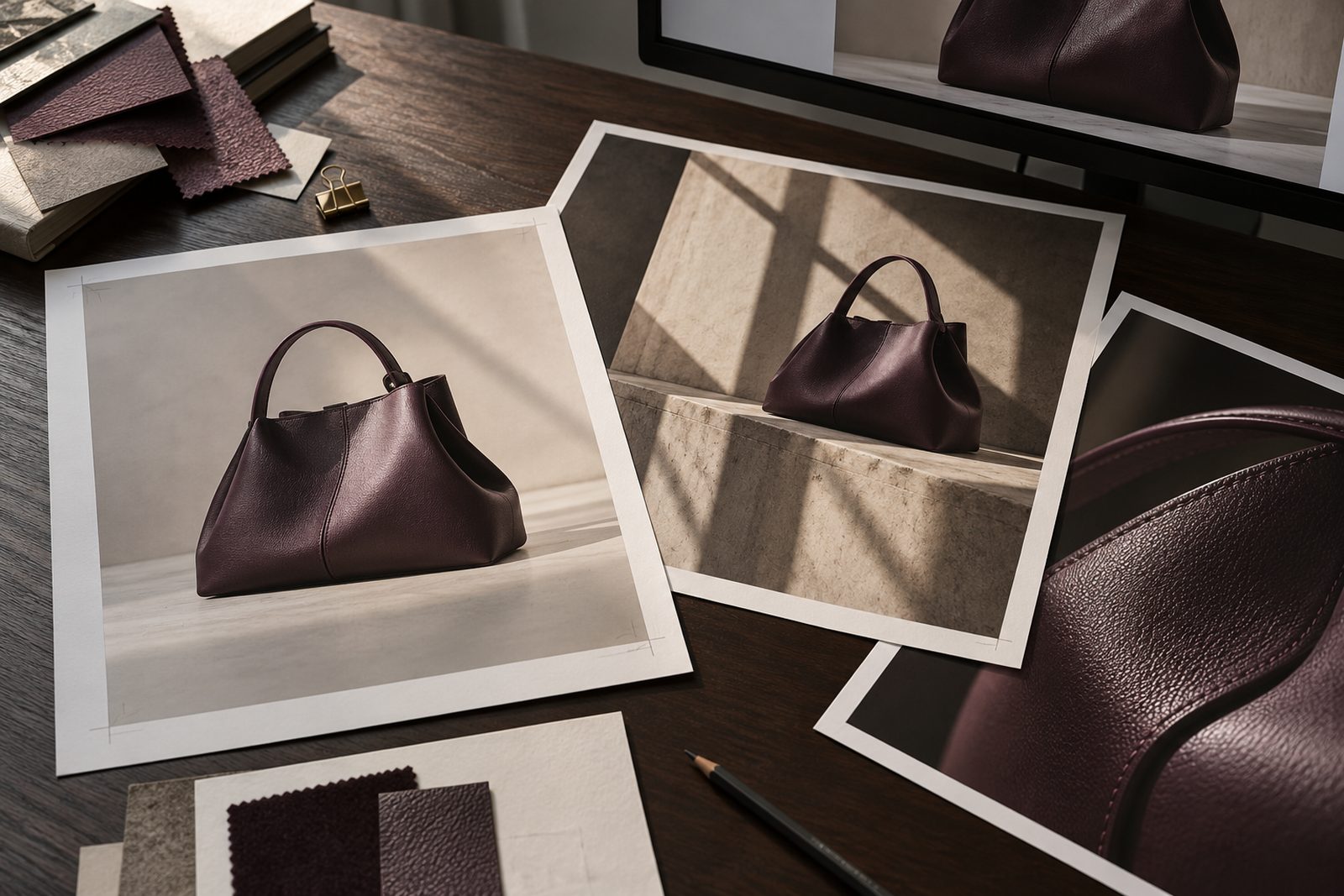
Then I explore visual references. I might use Pinterest to study settings, styling, color, composition, or an interesting way to tell the story.
The purpose is to develop a direction I can explain.
Why this environment? Why this mood? Why this way of showing the product?
Those choices help me give the tool useful instructions. They also give me a standard for evaluating what comes back.
Without that preparation, it’s easy to keep generating attractive images without knowing which one serves the business.
A campaign needs to hold together
One successful image is a starting point.
A campaign needs a consistent visual language across its assets. The product should remain recognizable. The styling, colors, atmosphere, and message should feel connected.
I want someone to move from an Instagram post to an email to a product page and recognize the same brand.
That takes direction across the whole experience, including deciding where an AI-generated asset is appropriate and where another production method would serve the work better.
AI and real shoots can work together
I don’t think a brand has to choose one approach for everything.
A real product photograph might provide the foundation for an imaginative setting. A physical shoot might capture the people and details that matter most, while AI supports selected concepts or variations.
The choice should follow the creative requirements and the team’s ability to deliver them accurately.
If the team cannot achieve the realism, consistency, or product accuracy the campaign requires with AI, a real shoot may be the better production choice.
The brand’s standard should guide that decision.
Hire for judgment
Before investing in AI creative, I would look closely at who will direct it.
Do they understand lighting, styling, texture, color, and composition? Can they interpret the brand? Can they explain how their creative choices connect to the intended buyer?
Experience on shoots can be valuable because it develops an understanding of how images are constructed. Just as important is the ability to recognize when an output falls short—and know what to change.
Ask to see a body of work. Ask about the process behind it. Look for consistency and deliberate choices.
The opportunity with AI is exciting. It gives creative teams more ways to explore and produce ideas.
The result still depends on someone knowing what they want to communicate, directing the work carefully, and deciding when it is ready to represent the brand.
At QR Consulting, creative direction begins with the buyer, the brand, and the business objective. Those decisions guide the tools we use and the work we put into the world.